

What if you could build a website around something as simple as horse names? Discover how this weird horse website makes money and ranks on Google.
It sounds almost too narrow to become a serious website topic. Yet one unusual niche site has attracted thousands of visitors from Google by doing exactly that.
Disclaimer: Some of the links in this article are affiliate links. If you click on the link and purchase the item, I may earn a commission at no extra cost to you.
Table of Contents
ToggleIntroduction: how this weird horse website makes money
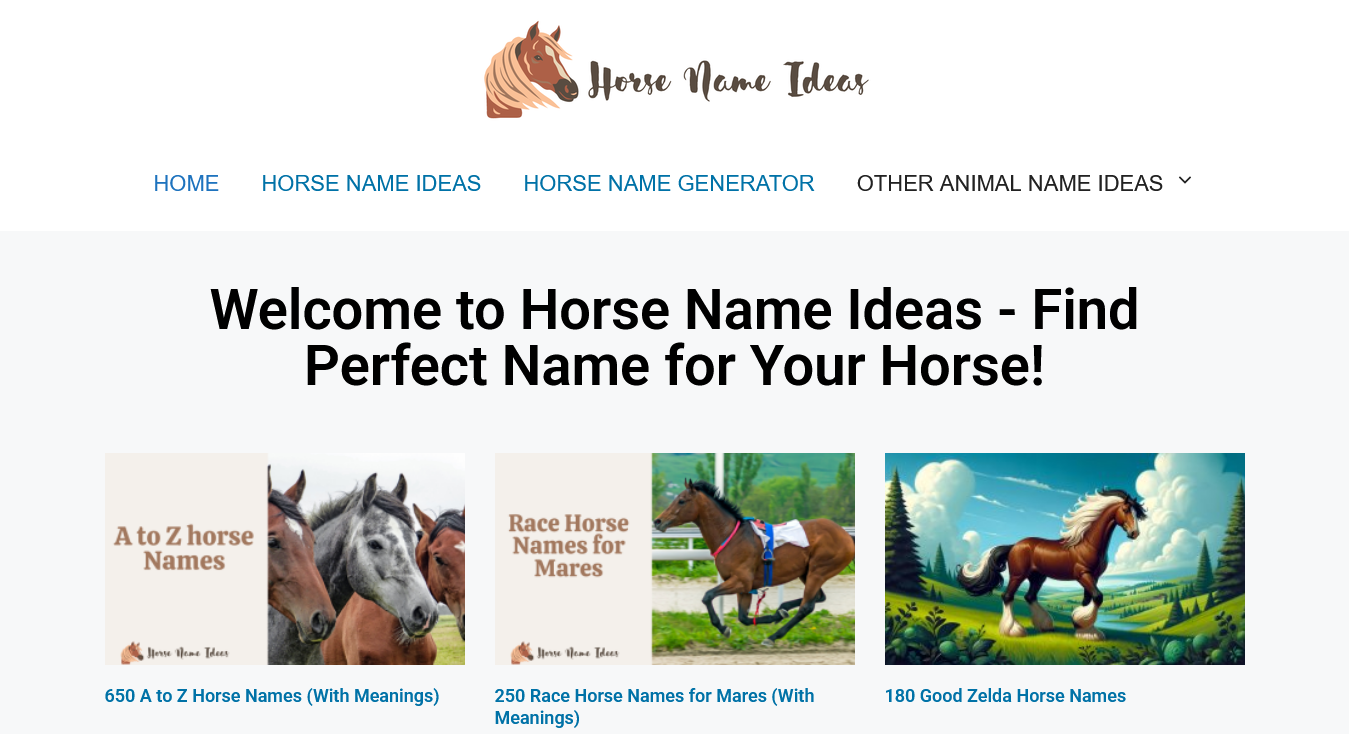
The website, Horse Name Ideas, focuses entirely on helping people find names for their horses. It publishes lists such as Crazy Horse Names, Western Horse Names, Black and White Horse Names, and many other variations.
It even has a horse-name generator.
At first glance, the site may look almost ridiculously simple. But its success highlights an important SEO lesson:
A small, highly focused niche can sometimes be easier to build than a broad website covering everything.
The site’s story offers useful ideas for anyone building a blog, niche website, or online business, especially if competing for broad keywords feels impossible.
What Is the Horse Name Website About?
The website is built around one very specific problem:
“What should I name my horse?”
Instead of trying to be a general horse-information website, it focuses on names. Visitors can find lists covering different types of horses and naming preferences, including:
- Crazy horse names
- Black horse names
- White horse names
- Western horse names
- Paint horse names
- Stallion names
- Unique horse names
- Funny horse names
- And many other categories
There is also a horse name generator that allows visitors to generate additional ideas.
The concept is remarkably straightforward. Someone needs a horse name, searches Google for ideas, discovers the website, and finds a large collection of possible names.
That simplicity is part of what makes the site interesting.
Why Is Such a Narrow Website Getting Google Traffic?
It is estimated that the website was receiving roughly 14,000–16,000 organic visitors per month at the time it was reviewed. More interestingly, the site’s search visibility had increased sharply following a Google core update.
So why would Google send traffic to such a simple website?
One major reason is its extremely focused topic. The website doesn’t try to rank for everything related to horses. It focuses on one particular subject: horse names.
That allows it to target many closely related long-tail searches.
The Power of Long-Tail Keywords
Consider the difference between these two keywords:
“horses”
and
“unique names for a black and white horse.”
The first keyword is enormous and potentially extremely competitive. The second is much more specific.
Someone searching for the second phrase has a very clear purpose. They aren’t looking for general information about horses. They need names. This is where long-tail SEO becomes particularly interesting for smaller websites.
Instead of competing for a huge keyword with thousands of established websites, a niche site can target hundreds or even thousands of highly specific searches.
For example:
- Horse names
- Black horse names
- White horse names
- Western horse names
- Female horse names
- Male horse names
- Funny horse names
- Cute horse names
- Strong horse names
- Unique horse names
Each search may have relatively modest demand. But collectively, these searches can form a meaningful stream of traffic.
A Narrow Topic Can Contain Hundreds of Keywords
This is one of the biggest lessons from the website. A niche doesn’t necessarily have to be large to contain many search opportunities. The key is depth.
Suppose you choose the topic “horse names.”
You can divide it according to:
Color
- Black horse names
- White horse names
- Brown horse names
- Grey horse names
Gender
- Male horse names
- Female horse names
Personality
- Funny horse names
- Cute horse names
- Fierce horse names
- Wild horse names
Style
- Western horse names
- Mythical horse names
- Elegant horse names
- Unique horse names
Purpose
- Racehorse names
- Show horse names
- Farm horse names
Suddenly, one seemingly tiny topic contains a large collection of potential content ideas. This is the basic principle of topic expansion.
Start with a narrow problem and explore all the different ways people search for solutions to that problem.
Why Low Competition Matters
A common mistake among new bloggers is choosing keywords based solely on search volume. They see a keyword with hundreds of thousands of searches and assume it must be a great opportunity.
But high search volume usually attracts competition. A smaller website may have a much better chance targeting a phrase with lower search volume but significantly less competition.
The horse-name website illustrates this idea beautifully. How many major websites are dedicated exclusively to horse names? Probably very few.
That means a highly focused site may have an opportunity to establish relevance around its subject without competing directly against enormous websites covering the broader horse industry.
The lesson isn’t:
“Always choose tiny keywords.”
The better lesson is:
“Look for the intersection of meaningful demand and manageable competition.”
Topical Focus Can Be a Strength
Imagine two websites.
Website A
It publishes:
- Horse names
- Recipes
- Technology
- Travel
- Personal finance
- Celebrity news
- Gardening
Website B
It publishes:
- Horse names
- Horse-name categories
- Horse naming guides
- Horse-name generators
- Horse-name ideas
Which website appears more clearly focused?
Website B.
A tightly defined topical structure can make it easier to build a coherent resource around a specific user need.
This doesn’t mean Google automatically rewards websites simply because they are narrow. Content still needs to be useful, accurate, original where appropriate, and created for people.
But when you’re building a small website, focus can make your strategy much more manageable.
The Content Is Surprisingly Simple
Another interesting feature is the simplicity of the content.
One example discussed in the case study contains a list of hundreds of horse names along with meanings. There isn’t necessarily a complicated 3,000-word tutorial behind every keyword.
This challenges another common assumption in blogging:
Every article must be extremely long to rank.
That isn’t true. The appropriate length depends on the search intent.
If someone searches:
“250 crazy horse names”
they may primarily want exactly that: a useful list of names.
Giving them 250 relevant suggestions may be more valuable than writing 2,000 words about the history of horse naming.
The objective should therefore be:
Answer the searcher’s need completely; not artificially increase the word count.
The Horse Name Generator Adds Something Useful
The site also provides a horse-name generator. This is important because it turns the website from a collection of static articles into something visitors can interact with.
Instead of simply reading a list, users can generate additional names. That creates another potential reason to stay on the site. This offers a useful lesson for bloggers:
Can you turn information into a tool?
For example, a website about:
- Blogging could have a headline generator.
- SEO could have a title checker.
- Fitness could have a calorie calculator.
- E-commerce could have a profit calculator.
- Writing could have a word-count or readability tool.
A simple tool can sometimes give a website an advantage over pages that only provide text.
Don't Confuse Simplicity With Poor Quality
The website’s concept is simple. That doesn’t mean the underlying SEO opportunity is simple. The real work is understanding the audience.
A horse owner who searches for “funny horse names” doesn’t necessarily want an academic discussion about horses. They want ideas.
A good website recognizes this intent and delivers the answer quickly. This is an important principle for content creators:
Useful doesn’t always mean complicated.
Sometimes the best content is simply the content that solves a very specific problem efficiently.
The About Page Raises an Interesting Question
The original case study also examined the site’s About page. It presented a team of experienced writers who supposedly had extensive knowledge of horses.
If you’re building a niche website, your About page should accurately explain:
- Who operates the site
- What experience you have
- Why the site exists
- How content is created
- How information is reviewed
- How readers can contact you
Trust matters.
A clever SEO strategy should never depend on pretending to have credentials or experience you don’t actually possess.
Could You Build a Website Like This?
Yes, but don’t interpret this case study as proof that any random micro-niche will become successful. The opportunity comes from finding a real problem with enough demand and building a genuinely useful resource around it.
Horse names are one example. There are countless other everyday problems people search for online.
People search for:
- Baby names
- Pet names
- Business names
- YouTube channel names
- Character names
- Gaming usernames
- Gift ideas
- Wedding ideas
- Home organization ideas
- Garden ideas
- Travel itineraries
The opportunity isn’t necessarily in copying the exact subject. It’s in recognizing the underlying pattern:
People search Google for ideas when they don’t know what to choose.
That can be an excellent starting point for niche content.
How to Find Your Own Micro-Niche
If this case study has inspired you to look for a small niche, don’t begin by asking:
“What website can I copy?”
Instead, follow a simple process.
Step 1: Find a Specific Problem
Look for something people repeatedly need help with. The problem doesn’t have to be complicated. For example: “What’s a good name for my horse?” is enough.
Step 2: Look for Search Variations
Once you’ve found the problem, brainstorm all the ways people might search for it.
For horse names, that might include:
- Names by color
- Names by gender
- Names by personality
- Names by breed
- Funny names
- Unique names
- Traditional names
- Famous names
This can reveal dozens or hundreds of related topics.
Step 3: Check Competition
Search Google for your potential keywords. Look carefully at the results.
Are the first-page results dominated by huge, authoritative websites? Or do you see small niche websites, forums, list pages, and relatively weak results?
If the competition is manageable, the opportunity becomes more interesting.
Step 4: Look Beyond Search Volume
Don’t reject a keyword simply because its individual search volume appears small.
Imagine finding 300 closely related long-tail searches. If each brings a small amount of traffic, the combined opportunity could still become significant. This is one of the attractions of a tightly focused niche.
Step 5: Build Something Better
Don’t simply create another list.
Ask:
“What would make my version more useful?”
You could add:
- Better categorization
- A generator
- Filters
- Examples
- Explanations
- Original research
- User contributions
- Frequently asked questions
- Better navigation
The objective is to build a resource rather than a pile of keywords.
Don't Build a Niche Solely for Google
There is one particularly important warning from this example.
It’s tempting to see a website like this and think, “I can find a tiny keyword, publish hundreds of pages, and Google will send me traffic.” That’s not a reliable strategy.
- Search algorithms change.
- Competitors improve.
- Search behavior changes.
- AI-generated content has also made the internet dramatically more crowded.
Instead, build around a genuine audience need. If Google sends visitors, that’s excellent. But your website should still be useful when the search engine isn’t involved.
A generator, useful resource, newsletter, community, or recognizable brand can help turn search visitors into returning users.
How to Monetize a Small Niche Website
The case study estimated relatively modest advertising revenue because the site did not appear to have an obvious monetization system at the time of analysis.
This raises another useful point:
Traffic isn’t the same thing as income.
A website can attract thousands of visitors and still make very little money if it doesn’t have an appropriate monetization strategy.
Depending on the niche, potential options include:
Display advertising
Once traffic reaches a suitable level, display advertising can generate revenue from page views.
Affiliate marketing
If visitors are buying related products, affiliate recommendations can potentially generate commissions.
For a horse-related website, this could theoretically include relevant products such as horse-care equipment, books, accessories, or other appropriate products.
Digital products
A website could potentially sell:
- Naming guides
- Printable resources
- Templates
- Databases
- Specialized guides
Lead generation
If the niche has businesses serving the audience, a website could potentially generate leads for relevant services.
The best monetization method depends on what the audience actually wants to buy.
The Bigger Lesson: Start Small, Then Think Big
One of the most valuable lessons from this unusual website is that you don’t necessarily need a massive subject to start an online business. A narrowly defined problem can sometimes provide a clearer path.
Instead of:
“I want to build a website about pets.”
you might investigate:
“I want to help new dog owners choose names, supplies, and training resources.”
Instead of:
“I want to build a technology website.”
you might begin with:
“I want to help small businesses choose practical AI tools.”
Instead of:
“I want to write about blogging.”
you might focus on:
“I want to help absolute beginners create and grow their first blog.”
A narrow starting point doesn’t mean you can never expand. It simply gives you a clear audience to serve first.
What This Weird Website Teaches Us About SEO
The horse-name website may look unusual, but its underlying strategy contains several valuable lessons.
1. Small niches can contain significant search opportunities
A topic that sounds tiny can contain hundreds of related search queries.
2. Long-tail keywords can be powerful
Highly specific searches may have less competition than broad terms.
3. Search intent matters
If people want a list of names, give them a useful list of names.
4. Topical focus can help create a coherent resource
A website that concentrates on one problem can build depth around that subject.
5. Simple content can be effective
Don’t add unnecessary words simply to reach an arbitrary word count.
6. Interactive tools can increase usefulness
A simple generator can transform a static information site into a useful resource.
7. Traffic isn’t automatically revenue
A website needs a sensible monetization strategy if the goal is to create an online business.
8. Don’t imitate the surface—understand the strategy
The goal isn’t to create another horse-name website.
The goal is to understand why a highly focused website can compete for specific searches.
Concluding Remarks
The story of this strange horse-name website is entertaining, but the SEO lesson behind it is surprisingly practical.
- You don’t always need to build the biggest website in your industry
- You don’t necessarily need to target the broadest keywords
- And you don’t have to create enormous articles about every subject.
Sometimes, the opportunity is hidden in a small problem that thousands of people need to solve.
- Find that problem
- Understand how people search for it
- Build a genuinely useful resource
- Cover the topic thoroughly without adding unnecessary fluff
Then give visitors something more
- a tool,
- a useful database,
- a better experience,
- or a reason to return.
The biggest lesson isn’t that Google loves weird websites. It’s that a well-focused website can turn an apparently tiny idea into a meaningful source of search traffic.
And for a new blogger or niche-site builder, that may be one of the most useful SEO lessons of all.
Read More:
Image Source Acknowledgement: Unsplash